
Tips & Tricks
•
3 Jul, 2026

A straightforward guide to restaurant booking system pricing, what drives the cost, what the market charges, the commission trap to avoid, and how to find the right fit for your venue.
No jargon, no spin. This guide gives you honest, practical answers, including where ResDiary Evo fits and where it might not be the right choice.
Jump to:
If you’ve ever tried to get a clear price from different reservation system providers, you’ve probably run into the same problem every operator does: nobody gives you a straight answer.
That's partly because costs genuinely vary by venue, the right plan for a 40-cover neighbourhood bistro looks very different from the right plan for a group of 15 sites. But it's also because the true cost of a booking system isn't just the monthly fee. Commissions, add-ons, integration costs, and contract terms all play a role.
This guide breaks down how hospitality reservation software is priced, what the main platforms charge, and what questions to ask before you sign anything.
The short answer:
Restaurant reservation system costs range from free tools with limited features all the way up to premium platforms with monthly fees, per-cover commissions, and paid add-ons.
The most important number isn’t the monthly price, it’s the total cost of ownership once commissions, add-ons, and booking volume are taken into account.
Most hospitality reservation software is priced on some combination of the following factors. Understanding each one helps you compare options on a true like-for-like basis.
This is the single most important factor when comparing restaurant reservation system costs, and the one most likely to catch venues out.
A flat-fee model means you pay a fixed monthly amount regardless of how many bookings you take. A commission-based model means you pay a fee per cover or a percentage on bookings made through the platform's consumer-facing app. Commissions are often framed as small, £1 to £2 per cover is common, but at volume, they compound quickly.
Higher tiers typically unlock features like marketing automation, advanced CRM, or multi‑venue tools. Choose based on what you need now and what you’ll need within the next year.
Most platforms charge separately for tools like SMS messaging, gift vouchers, events, deposits, and POS integrations. These extras can significantly shift your true monthly cost.
Some providers charge onboarding fees or lock venues into long-term contracts. Always check whether renewal pricing changes.
A restaurant that takes 1,500 covers/month at £1.50 commission per cover pays:
£2,250 per month - £27,000 per year - in commissions alone.
That’s before any subscription fee.
“We regularly speak to venues who discover they've been paying thousands per year in unexpected commission fees. Most don't realise how fast those charges snowball, especially once you account for every channel the booking came through.” - Ross Beattie, ResDiary Sales Manager
To make this concrete, here's how the numbers play out for two typical venue types, one independent, one larger, across a flat fee vs. commission model.
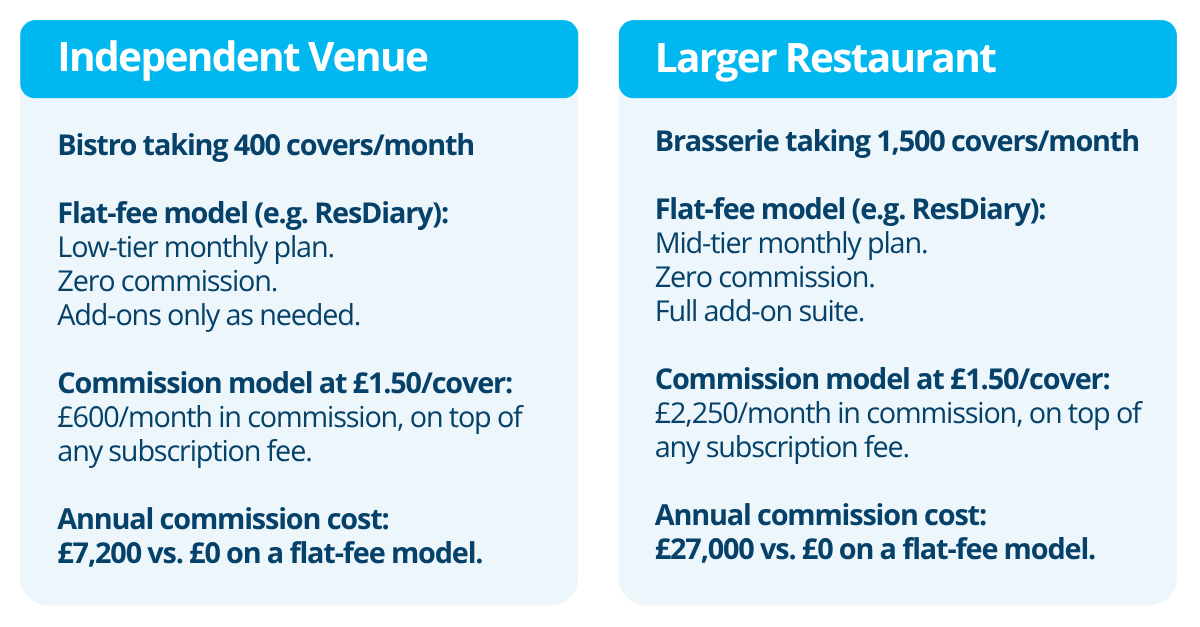
These examples use a conservative £1.50 per cover. Some platforms charge more, and the commission applies every month, on every booking, whether your venue is growing or not.
Here's an honest look at how the main platforms in the market are priced, and what you get for your money.
Performance and Enterprise tiers. Strong EU consumer app presence. Some bookings from the TheFork app may incur additional charges - important to confirm before signing.
High-end CRM-focused platform. Zero commissions, advanced marketing automation, best suited to groups and enterprise-level operators.
|
Feature
|
ResDiary
|
OpenTable
|
TheFork
|
Sevenrooms
|
|
Pricing model
|
Usage-based subscription
|
Subscription + commission
|
Subscription + commission
|
Subscription
|
|
Commission on bookings
|
Zero commission
|
Yes
|
Yes
|
Zero commission
|
|
Consumer diner network
|
DesignMyNight
|
OpenTable
|
TheFork
|
None
|
|
Add-ons / modularity
|
Yes - flexible
|
Limited
|
Limited
|
Yes
|
|
Data ownership
|
Venue owns all data
|
Provider owns data
|
Confirm with provider
|
Venue owns data
|
|
Coverage
|
Global
|
Global
|
Primarily Europe
|
Global
|
|
Around the clock support
|
Yes
|
Yes
|
Yes
|
Yes
|
All competitor information is based on publicly available data at the time of writing (March 2026). Always confirm current pricing, commission structures, and terms directly with the provider before making a decision.
.png?width=800&height=250&name=ResDiary%20TAYA%20(1).png)
Every ResDiary Evo plan, regardless of tier, includes the following as standard:
Want to understand each feature in more depth? See ResDiary feature overview →
UK restaurants see average no-show rates of 7%. Automated booking confirmations, SMS reminders, and the option to take credit card guarantees or deposits are among the most effective tools for bringing that number down. A restaurant recovering just half its no-shows translates to thousands of pounds of recovered revenue per year.
Want to go deeper? Read our guide: How to reduce no-shows at your restaurant →
A reservation system with integrations across Google, Meta, and DesignMyNight means your venue is bookable wherever diners are searching, without paying a commission on those bookings. That discoverability has real commercial value that doesn't show up in any monthly fee comparison.
Read more: How ResDiary works with Google Reservations →
Every automated confirmation, reminder and phone booking handled by your reservation system and its integrations is time your front-of-house team doesn't spend on admin during service. Over a week, that adds up to meaningful hours redirected toward the guest experience.
.png?width=800&height=250&name=ResDiary%20TAYA%20(2).png)
Before signing up to any hospitality reservation software, whether that's ResDiary or anyone else, these are the questions that give you the clearest picture of the true cost:
ResDiary publishes clear answers to most of these on its pricing and FAQ pages. If a provider can't answer these questions directly, that's worth noting.
Last updated March 2026. Competitor pricing references are based on publicly available information and should be verified directly with each provider.
.png?width=680&height=383&name=ResDiary%20Evo%20CTA%20(1).png)